Biography
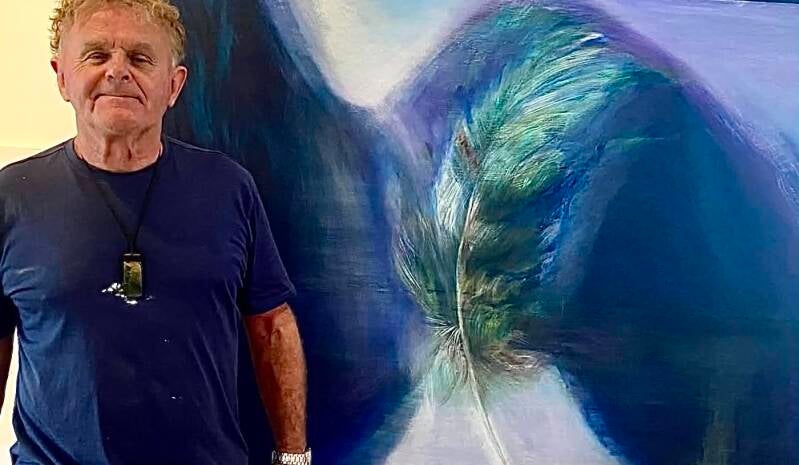
The multi award- winning artist Chris Wilkie MFA (Hons). BFA, Dip Tch. etc. developed a powerful exploration of LANDSCAPES infused with a sense of Loss of species and ancient culture. These began in his native NORTHLAND / Tai Tokerau of New Zealand after his first degree.
Becoming known for massive Narrative Murals. He nevertheless primarily focussed on easel works, hosting his first solo exhibition in 1987. From a post-Elam Art School abstract beginning, he gradually began to develop a dreamy, meditative realism in his oil paintings and graphite drawings. All of his adult art focussed on places, people and the damaged biota of this once fought- over region.
The artist began with the rendition of local mountains/ maunga, pakanga and battle sites, and people in the area. Gradually they narrowed down to "COLONIAL BRIDES" of the Settler era - a field he called: "Pakeha Whakapapa"/ Colonial Malaise, stating to the critic Larry Jenkins "... that we all had mud between our toes". This work continued from 1992- 2002, when Wilkie began a Master Degree. Even within that degree, Wilkie chose humane subjects, and wrote a Dissertation called: "A Suspicion of Fire; land issues in Northland, past and present".
Wilkie's Master Degree was supervised by Professor Dr. Paul Moon, a noted historian, and David Rankin, a polemical Ngapuhi kaumatua, who deliberately chose to make Wilkie "noa" or able to deal spiritually and factually with quite difficult, restricted or "tapu" subject matter - including relating information about his famous ancestors Kawiti, Hone Heke Pokai, Tamati Waka Nene and Hongi Hika - all major figures in the skirmishes between Europeans and indigenous tangata whenua, in the mid Nineteenth Century, and direct ancestors of his ex-wife. Wilkie's Master Degree led to a distinct shift in Chris Wilkie's repertoire. It became much more focussed on CONFLICTING HISTORIES, and an interest in ECOLOGICAL ISSUES- as the artist found so much of his country had been changed and altered after the arrival of once- pristine islands.
To an extent, the CONTEMPLATION OF LANDSCAPES - for their beauty next to fracture and damage, is the basic interest of Chris Wilkie to this day.
The new oil paintings began with diptychs begun in Te Hue Bay, in The Bay of Islands, New Zealand. In those major works, which were finally shown in Wellington's Kura Gallery of Contemporary Maori Arts in 2008-9, the artist contemplated the fate of the French navigator Marion du Fresne, who died here in 1770 after an attack by local Maori. The countering revenge by the French led Wilkie to consider how humanity brought so many travails to these shores, hurting each other, and the ancient species which were here alone, millions of years before humanity appeared.
In a show (opened by Assoc. Minister of The Arts Kath Tizard and Sir Geoffrey Palmer, a former Prime Minister) titled: "Radiance and Remorse" (after Brian Boyd's classic biography of Nabokov). Each oil had a diptych pair, and a strong biological or conservation aspect. Beginning in Northland, the cycle continued for several years 2004-8,and carried Wilkie from the top of his native islands, to the very bottom of the South Island. Hence the works evolved, and took on more national vs. regional aspects of topography, symbols, and even atmospheric conditions.
Wilkie began engaging with far-flung FIORDLAND - ATAWHENUA IN 1980. entranced with one of the world's last great wilderness areas. He moved there in late 2005 and returned to Northland in 2011. He still visits The South frequently and was an artist on board the ship HMV Flightless in November 2025, generously sponsored by PURE SALT CHARTERS. There he began more of his specialist ecological- historical paintings. Wilkie avowed many times to associates that is he hadn't been an Artist, he would have been a Biologist.